Common Mistakes When Using Filler Masterbatch in Extruded Polystyrene (XPS) Production
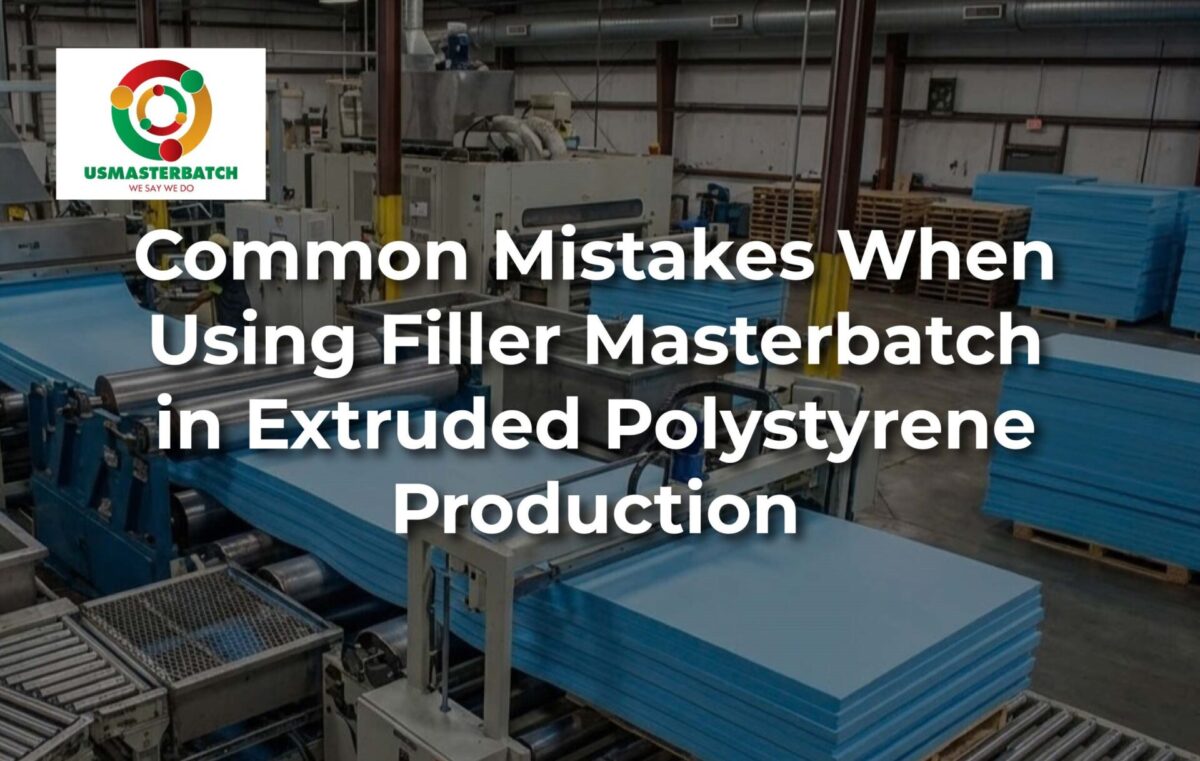
[US Masterbatch] Extruded polystyrene (XPS) is widely used in construction, insulation, and packaging thanks to its excellent thermal insulation, compressive strength, and moisture resistance. To reduce costs and tailor material properties, many manufacturers incorporate filler masterbatch into XPS formulations. However, improper use of filler masterbatch can lead to serious quality issues, production instability, and long-term performance problems.

1. Using Incompatible Filler Types in Extruded Polystyrene (XPS) Production
One of the most frequent mistakes is selecting a filler masterbatch that is not compatible with polystyrene (PS).
Many filler masterbatches on the market are designed primarily for polyolefins such as PE or PP. When these fillers are used in XPS applications, poor dispersion and weak interfacial bonding can occur.
Consequences:
- Reduced mechanical strength
- Poor surface finish
- Increased brittleness
- Non-uniform cell structure in XPS foam
Best practice:
Always ensure that the filler masterbatch is specifically formulated for polystyrene systems, with appropriate carrier resin and surface-treated fillers (e.g., coated calcium carbonate).
2. Excessive Filler Loading in Extruded Polystyrene (XPS) Production
Cost reduction is often the main motivation for adding filler masterbatch, but overloading filler content is a critical mistake.
In XPS production, material balance is extremely sensitive. Excessive filler disrupts melt strength, gas retention, and foam expansion.
Consequences:
- Collapse of foam cells
- Increased density
- Poor thermal insulation performance
- Cracks or surface defects
Best practice:
Carefully control filler addition levels. Conduct trials to identify the maximum filler loading that maintains required mechanical and insulation properties. More filler does not always mean better cost efficiency if scrap rates increase.
3. Ignoring Particle Size and Distribution in Extruded Polystyrene (XPS) Production
Another common oversight is neglecting filler particle size and size distribution.
Large or poorly controlled particles act as stress concentration points and interfere with foam cell nucleation during extrusion.
Consequences:
- Irregular cell size
- Weak internal structure
- Reduced compressive strength
- Visible surface imperfections
Best practice:
Use filler masterbatch with fine, narrow particle size distribution and excellent dispersion. Micronized fillers with surface treatment are preferred for XPS applications.
4. Poor Dispersion Due to Low-Quality Masterbatch in Extruded Polystyrene (XPS) Production
Low-quality filler masterbatch often has inadequate compounding, leading to agglomeration during extrusion.
In XPS lines, poor dispersion is particularly problematic because foam extrusion amplifies any material inconsistency.
Consequences:
- Streaks and color variation
- Melt flow instability
- Die buildup and pressure fluctuation
- Frequent line stoppages
Best practice:
Choose filler masterbatch from reliable manufacturers using twin-screw or multi-screw compounding technology. Consistent dispersion is essential for stable XPS production.
5. Not Adjusting Processing Parameters in Extruded Polystyrene (XPS) Production
Many producers add filler masterbatch but fail to adjust extrusion parameters accordingly.
Filler addition changes melt viscosity, heat transfer, and gas solubility. Running the same settings as virgin PS is a common mistake.
Consequences:
- Unstable extrusion pressure
- Poor foam expansion
- Increased energy consumption
- Reduced production efficiency
Best practice:
Re-optimize:
- Barrel temperature profile
- Screw speed
- Back pressure
- Blowing agent dosage
Even small formulation changes require process fine-tuning in XPS lines.
6. Overlooking Moisture Content in Extruded Polystyrene (XPS) Production
Moisture control is critical in XPS production, yet filler masterbatch is sometimes introduced without proper drying.
Fillers such as calcium carbonate can absorb moisture during storage and transport.
Consequences:
- Bubble collapse
- Surface pinholes
- Poor foam uniformity
- Increased scrap rate
Best practice:
Ensure filler masterbatch has low and stable moisture content. Implement proper drying or sealed storage systems before feeding material into the extruder.
7. Compromising Long-Term Performance in Extruded Polystyrene (XPS) Production
Some manufacturers focus only on short-term processing results and ignore the long-term performance impact of filler masterbatch.
In XPS used for insulation, long-term thermal stability and mechanical strength are crucial.
Consequences:
- Reduced compressive strength over time
- Shrinkage or warping
- Decline in insulation efficiency
- Customer complaints and product returns
Best practice:
Test finished XPS boards for aging performance, thermal conductivity, and compressive strength after adding filler masterbatch. Ensure compliance with relevant standards.
8. Choosing Price Over Consistency in Extruded Polystyrene (XPS) Production
A final but critical mistake is selecting filler masterbatch based solely on lowest price.
Inconsistent raw materials lead to batch-to-batch variation, which is especially harmful in foam extrusion processes like XPS.
Consequences:
- Unstable production
- Frequent parameter adjustments
- Higher rejection rates
- Increased overall production cost
Best practice:
Evaluate filler masterbatch suppliers based on:
- Quality consistency
- Technical support
- Application experience in XPS
- Stable supply capability
A slightly higher material cost often results in lower total production cost.

Conclusion
Filler masterbatch can be an effective tool for cost optimization and property adjustment in extruded polystyrene production — but only when used correctly. Common mistakes such as incompatible fillers, excessive loading, poor dispersion, and inadequate process adjustments can severely compromise product quality and production stability.
By selecting the right filler masterbatch, controlling formulation levels, optimizing processing conditions, and working with experienced suppliers, manufacturers can achieve a balance between cost efficiency and high-performance XPS products.
Investing in proper material selection and technical validation will ultimately lead to more reliable production, satisfied customers, and long-term success in the competitive XPS market.