What is HIPS Polystyrene? Properties and Applications
1. What is HIPS Polystyrene?

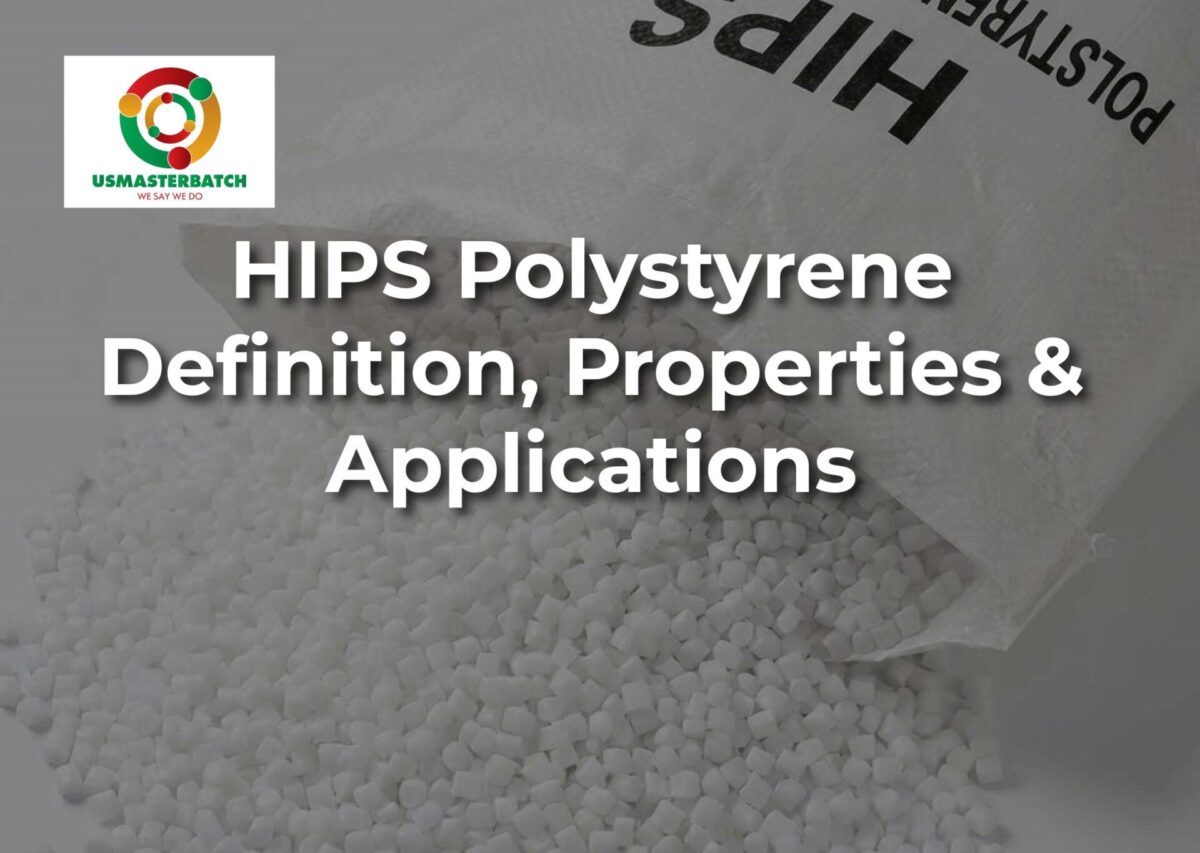
HIPS Polystyrene (High Impact Polystyrene) is a thermoplastic polymer belonging to the Polystyrene family, specifically engineered to offer higher impact resistance compared to conventional GPPS (General Purpose Polystyrene). HIPS is produced by blending Polystyrene with Polybutadiene rubber, which significantly reduces brittleness and improves toughness.
In industrial applications, HIPS is widely chosen due to its balanced performance, easy processing, and competitive cost. When combined with filler masterbatch and additive solutions from US Masterbatch, HIPS can be further optimized in terms of cost efficiency, stiffness, surface quality, and processing stability.
2. Material Structure of HIPS
HIPS is a two-phase material consisting of:
- Polystyrene (PS) matrix: provides rigidity, surface smoothness, and good processability.
- Dispersed Polybutadiene rubber phase: absorbs impact energy and enhances toughness.
This structure allows HIPS to maintain a strong balance between mechanical properties and economic efficiency, making it ideal for compound and masterbatch-based solutions developed by US Masterbatch.
3. Key Properties of HIPS Polystyrene
3.1. Improved Impact Resistance
Compared with GPPS, HIPS offers significantly better impact strength, making it suitable for rigid packaging, appliance housings, and consumer products. By using CaCO₃ filler masterbatch from US Masterbatch, manufacturers can fine-tune stiffness and dimensional stability while maintaining sufficient impact performance.
3.2. Excellent Processability
HIPS is compatible with common processing methods such as:
- Injection molding
- Extrusion
- Thermoforming
US Masterbatch provides processing aid masterbatches that help stabilize melt flow, reduce defects, and improve production efficiency on HIPS processing lines.
3.3. Smooth Surface and Aesthetic Quality
HIPS features a smooth, matte surface that is easy to print, paint, or laminate. US Masterbatch offers solutions to:
- Increase whiteness and opacity
- Improve surface uniformity
- Enhance color dispersion
These properties are especially valuable for advertising boards, display systems, and premium packaging.
3.4. Good Electrical Insulation
HIPS provides reliable electrical insulation and is commonly used in housings for household electrical and electronic products. Additive solutions from US Masterbatch can further enhance material stability and safety.
3.5. Recyclability and Cost Optimization
HIPS is recyclable under PS resin code #6. By incorporating CaCO₃ filler masterbatch from US Masterbatch, manufacturers can significantly reduce raw material costs while maintaining acceptable mechanical and processing performance.
3.6. Limitations of HIPS
Despite its advantages, HIPS has some limitations:
- Moderate heat resistance (typically below 90°C)
- Limited chemical resistance
- UV sensitivity for outdoor applications without stabilizers
US Masterbatch provides additive solutions to mitigate these limitations depending on end-use requirements.
4. Applications of HIPS with US Masterbatch Solutions
4.1. Rigid and Thermoformed Packaging
HIPS is widely used for:
- Food trays
- Thermoformed containers
- Disposable rigid packaging
US Masterbatch filler and additive solutions help improve stiffness, thermoforming stability, and cost efficiency for high-volume production.
4.2. Electrical and Electronic Appliances
HIPS is suitable for:
- TV and monitor housings
- Small household appliance covers
- Insulating components
US Masterbatch offers customized compound and masterbatch solutions to ensure dimensional stability, surface consistency, and reliable processing.
4.3. Household and Consumer Products
Products such as storage boxes, trays, and appliance housings benefit from HIPS combined with filler masterbatch, achieving a balance between durability, appearance, and cost.
4.4. Advertising and Display Applications
HIPS sheets are commonly used for indoor advertising boards, display stands, and exhibition structures. US Masterbatch solutions help:
- Increase sheet rigidity
- Reduce warpage
- Improve cutting, printing, and bonding performance
5. Technical HIPS Solutions from US Masterbatch
5.1. CaCO₃ Filler Masterbatch for HIPS Cost Optimization
Using 100% virgin HIPS often leads to high production costs. US Masterbatch supplies high-quality CaCO₃ filler masterbatch specifically designed for HIPS, enabling:
- Raw material cost reduction
- Improved stiffness and dimensional stability
- Stable thermoforming and extrusion performance
Filler loading levels can be customized based on application requirements.
5.2. Processing Stability and Defect Reduction
Common HIPS processing challenges include melt instability, surface defects, and post-forming deformation. US Masterbatch addresses these issues with processing aid and performance additive solutions, resulting in:
- Lower scrap rates
- Higher machine productivity
- Extended equipment lifespan
5.3. Whiteness and Surface Enhancement Solutions
For applications requiring high aesthetic quality, US Masterbatch provides:
- Whiteness-enhancing masterbatch
- Surface smoothing additives
- Improved pigment dispersion systems
6. Industry-Specific Applications – US Masterbatch Perspective
6.1. Packaging Industry
HIPS combined with US Masterbatch solutions is widely used in thermoformed food packaging and rigid containers, focusing on cost optimization, consistent quality, and stable forming performance.
6.2. Electrical & Electronics Industry
For appliance housings, US Masterbatch emphasizes dimensional stability, surface appearance, and electrical insulation, providing HIPS-based solutions as cost-effective alternatives to ABS.
6.3. Advertising and Display Industry
US Masterbatch supports HIPS sheet producers with solutions that improve rigidity, flatness, and printability, meeting the demands of indoor advertising and display applications.
7. Market Trends and the Future of HIPS with Filler Masterbatch
Current market trends indicate:
- Increasing demand for cost-optimized plastic formulations
- Growing adoption of filler masterbatch instead of 100% virgin resin
- Higher expectations for technical support and customized solutions
US Masterbatch continues to develop advanced filler masterbatch and additive solutions aligned with these trends.
8. Conclusion
HIPS Polystyrene is a versatile thermoplastic offering a strong balance between performance and cost. When combined with CaCO₃ filler masterbatch and additive solutions from US Masterbatch, manufacturers can:
- Reduce production costs
- Improve processing stability
- Customize material properties for specific applications
US Masterbatch is not only a material supplier, but a technical solution partner, helping customers enhance competitiveness and achieve sustainable growth.
9. Detailed Processing Guidelines for HIPS with US Masterbatch Solutions
To maximize the performance of HIPS compounds, US Masterbatch provides technical guidance covering the entire processing cycle.
9.1. Injection Molding of HIPS
HIPS is widely used in injection molding due to its stable melt behavior and good surface appearance. When combined with CaCO₃ filler masterbatch from US Masterbatch:
- Melt flow can be adjusted to suit different mold designs
- Cycle time can be reduced through improved cooling efficiency
- Dimensional stability of molded parts is enhanced
Typical processing temperatures range from 180–240°C, depending on filler loading and part thickness. US Masterbatch supports customers in optimizing screw design and processing parameters for consistent output.
9.2. Extrusion and Sheet Production
For HIPS sheet extrusion, especially for thermoforming applications, material consistency is critical. US Masterbatch solutions help:
- Improve sheet flatness and thickness uniformity
- Reduce melt fracture and surface defects
- Enhance stiffness without sacrificing formability
This is particularly important for food trays, disposable packaging, and advertising sheets produced at high line speeds.
9.3. Thermoforming Performance
HIPS is one of the most popular materials for thermoforming. By using US Masterbatch filler and processing additives:
- Heating windows become wider and more stable
- Sag control during forming is improved
- Finished parts show less warpage and better dimensional accuracy
10. Quality Consistency and Raw Material Control
One of the major challenges for plastic manufacturers is maintaining consistent quality across different production batches. US Masterbatch addresses this by:
- Strict control of CaCO₃ particle size and surface treatment
- Consistent dispersion technology to avoid agglomeration
- Stable carrier resin selection compatible with HIPS
These factors ensure predictable processing behavior and uniform mechanical properties, even at higher filler loadings.
11. Cost Analysis: Virgin HIPS vs. HIPS with Filler Masterbatch
From a commercial perspective, combining HIPS with CaCO₃ filler masterbatch offers clear advantages:
- Reduced dependency on virgin resin price fluctuations
- Lower overall compound cost per kilogram
- Improved margin stability for manufacturers
US Masterbatch works closely with customers to determine the optimal formulation that balances cost reduction and product performance, rather than applying a one-size-fits-all approach.
12. Sustainability and Responsible Material Use
As sustainability becomes increasingly important, US Masterbatch supports responsible material strategies by:
- Promoting recyclable HIPS formulations
- Enabling the use of recycled content where applicable
- Reducing overall polymer consumption through filler integration
These approaches help manufacturers move toward more sustainable production without compromising product quality.
Why Choose US Masterbatch for HIPS Applications?

Customers choose US Masterbatch for HIPS solutions because of:
- Deep technical expertise in filler masterbatch technology
- Application-specific formulation support
- Consistent product quality for global markets
- Flexible solutions tailored to customer machinery and end-use requirements
From rigid packaging to appliance housings and advertising sheets, US Masterbatch delivers reliable, scalable, and cost-effective HIPS solutions.
Final Remarks
HIPS Polystyrene remains a key material for manufacturers seeking a balance between performance, aesthetics, and cost. With the support of US Masterbatch’s CaCO₃ filler masterbatch and additive technologies, HIPS formulations can be precisely engineered to meet diverse market demands.
By partnering with US Masterbatch, producers gain access not only to materials, but also to long-term technical support, process optimization, and sustainable growth strategies.